Taxes & Legal
What are endowment funds? Benefits, founding steps, and providers
An endowment fund is a sub-fund managed by the founder within an umbrella foundation. Learn about the advantages and potential providers in this article.
—
12 minutes
The term "foundation fund" can sometimes cause confusion in its word composition, as funds primarily occur in the context of financial assets and investments. Foundations, on the other hand, stand for financial and/or material assets that are used for the permanent and sustainable fulfillment of a purpose specified by the founder – in most cases of a charitable nature.
In this blog article, we want to address the definition, potential advantages and disadvantages compared to foundations, and providers in Germany.
📚 Contents
What is a foundation fund?
An overview of the advantages of foundation funds
Disadvantages: When a foundation fund is not the right choice
Step by step to your own foundation fund
These providers of foundation funds you should know
Conclusion
What is a foundation fund?
Foundation funds are still largely unknown in Germany, but are enjoying growing popularity as they represent a good alternative to foundations and direct donations. There is no binding definition, however, but the term can basically be thought of in two directions. In this article, we follow the more common, latter definition.
The basic endowment of a foundation is usually invested profitably in order to finance the foundation's purpose from the returns (more on this later). The fund - which is ideally safe and profitable and into which the foundation's resources are placed - can be referred to as a foundation fund.
The more common definition of foundation funds refers to the contribution of capital to an existing umbrella foundation, thereby increasing the basic endowment of the foundation. This does not create an independent legal entity or corporation, but rather a sub-division (also called a small foundation) that can be managed by the founder of the foundation fund.
Fig. 1 - What are foundation funds? Exemplary presentation as an infographic
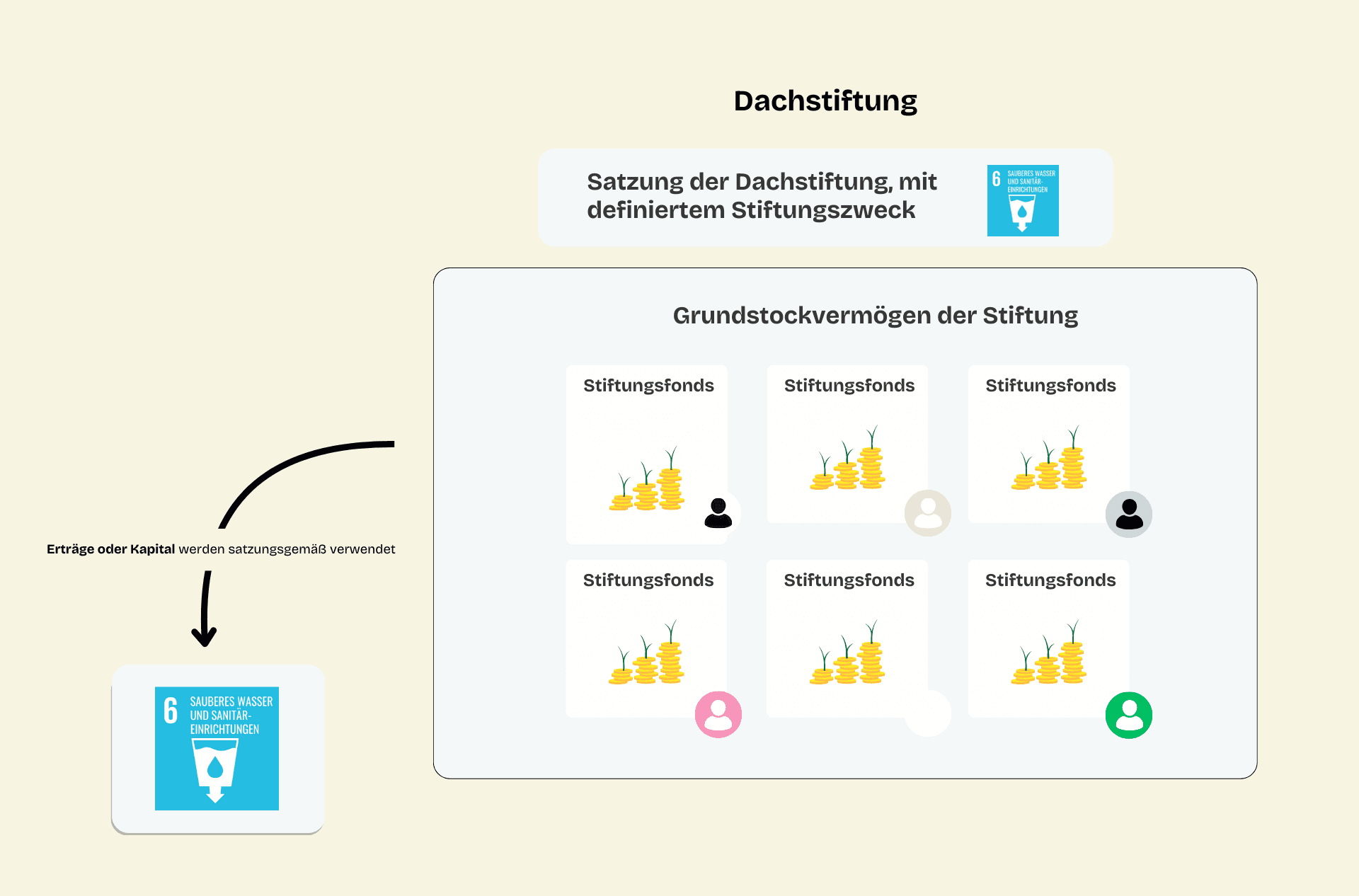
Depending on whether the foundation fund is established within a legally capable foundation or, for example, within a dependent trust foundation, the possibilities regarding the extent to which the money in the foundation fund can be used are limited.
In the case of legally capable foundations, as a rule, only the use of returns from the foundation's assets to promote organizations and projects is permissible. This limitation arises from the so-called preservation principle of the foundation's assets. Consequently, the level of support is limited. In the case of a consumable foundation or trust foundations, however, the seed capital can also be used for the support.
Fig. 2 - Preservation principle in umbrella foundations - Exemplary presentation as an infographic

The most important differences compared to foundations
A foundation fund is an attractive alternative to the classic charitable foundation, as the establishment process is simpler. Specifically, three points are different here:
💶 The costs: The establishment of a charitable foundation is associated with high capital requirements. There is no statutory minimum capital amount. However, in practice, the necessary starting assets for a legally capable foundation amount to a sum between 50,000 and 100,000 Euros. In addition, legal and financial consulting costs arise. In contrast, a foundation fund features a significantly lower cost level and, depending on the modalities of the umbrella foundation, is already accessible from an amount of 1,000 Euros.
Expert assessment - Alexander Vielwerth, Association and NPO Law
"To establish a real foundation that is legally capable and charitable requires a lot of capital. For a long time it was 50,000 Euros, today one rather assumes 100,000 Euros. This means that with a lower basic endowment, you don't even need to think about it because the foundation supervisory authority will usually not recognize it. Foundation funds - as special assets within a foundation - do not have this barrier to entry.”
🧠 The complexity: The establishment of a charitable foundation requires the drafting of a constitution, coordination with the foundation supervisory authority and the tax office, as well as continuous reporting after commencing foundation activities. Furthermore, legal and asset consulting is recommended. In contrast, the bureaucracy is eliminated with foundation funds, as the essential and at the same time complex tasks are usually handled by the umbrella foundation.
🤔 The flexibility: The core idea of a foundation is the long-term nature of its commitment. The foundation's purpose recorded in the constitution cannot be changed and remains unaltered over the entire duration of the foundation. Even with umbrella foundations that limit themselves to a few charitable purposes, a foundation fund depends on the purposes of the umbrella foundation. The maximum flexibility exists in foundation funds in an umbrella foundation whose constitution already comprehensively contains all permissible purposes. This is, for example, the case with a bcause foundation fund.
The most important differences compared to direct donations
Direct donations to NGOs are usually also cost-effective, uncomplicated, and flexible. The question arises as to why one should opt for a foundation fund.
An important aspect is the visibility of personal commitment. A foundation in the classic sense is often used as an instrument for communication measures by companies, families, or public figures. A direct donation is usually made anonymously and is therefore difficult to recognize for outsiders. On the other hand, a foundation fund opened in the name of the founder offers the opportunity to make the commitment significantly more visible. This visibility can be important, as values and goals can be publicly communicated in this way, which in turn could inspire others.
This leads to another difference: A foundation fund offers the option to raise donations from external third parties in order to multiply the fund capital and thus the impact. This makes it an instrument for fundraising campaigns or events where friends, family, or companies can contribute money specifically. Whether it's a birthday party, a corporate Christmas party, or crowdfunding - the fund offers many opportunities to multiply donations. Since one's own or a representative name is often chosen - e.g., Max Mustermann Foundation Fund - a personal connection can be created during donation appeals that matches the individual commitment.
A foundation fund can also be established by will and commissioned after a person's death, which would of course also be possible with a direct donation. However, the foundation fund bears the founder's name and outlasts them.
A direct donation to organizations also offers many advantages. Here, only the differences and motivations that speak in favor of choosing a foundation fund are discussed.
Are there foundation funds in other countries?
Yes, foundation funds also exist internationally; they are particularly widespread in the USA under the term Donor Advised Fund (DAF).
These funds enable donors to pay money into a fund managed by a charitable organization, whereby the donor can continue to influence how the funds are used. DAFs are a highly popular and, of course, tax-privileged way to engage philanthropically in the USA. They offer a flexible alternative to the classic foundation by minimizing administrative effort and enabling the donor to deploy their capital in a targeted and long-term manner for charitable purposes.
🔎 In our blog article, you can learn more about Donor Advised Funds and what impact they could have on engagement with money in Germany:
An overview of the advantages of foundation funds
Lower costs: Management by an umbrella foundation reduces consulting and administrative costs compared to setting up your own foundation.
Flexibility: Adaptability in focus to be able to respond to changing societal needs.
Systematic commitment: Long-term, continuous support because the capital is preserved and the returns are continuously used for the good cause.
Customizability: Some foundation funds offer the capability to support several charitable themes corresponding to the founder's interests over the long term.
Visibility: The fund can be managed under the name of the founder, enabling better public perception and a personal legacy.
Low bureaucratic effort: No complex coordination of different service providers, as the management is professionally taken care of.
Tax benefits: Additional tax incentives that go beyond the benefits of a direct donation.
Add-on donations possible: Tax-deductible contributions to the fund for external third parties.
Disadvantages: When a foundation fund is not the right choice
Of course, there are also situations in which a foundation fund is not the optimal solution. Especially if you desire independence or complete control, the model reaches its limits.
Operational activity of foundations
A foundation fund is usually not suitable if you want to actively participate in the day-to-day operations of charitable work. Anyone who wants to run their own operational foundation that independently conducts projects, employs staff, or issues invoices is severely limited with a foundation fund. The responsibility for operational tasks such as running projects or directly funding activities usually remains with the umbrella foundation. Exerting influence on daily decisions and activities is therefore not possible.
Dependence on the umbrella foundation
A foundation fund always depends on the structures and decisions of the higher-level umbrella foundation. This manages the assets and ultimately decides how the funds are invested and within which framework the returns are distributed. This can restrict flexibility if the founder's ideas differ from those of the umbrella foundation. In addition, administrative processes, such as the selection of investment strategies or the level of administrative costs, can be mandated by the umbrella foundation without the founder having any influence over them.
No tax privilege for very high assets
If very high assets are to be contributed to the foundation, for which the tax privilege of Section 10 para. 1a of the Income Tax Act (EStG - assertion over 10 years) is to be claimed, this is not possible in the case of a foundation fund that exists within a non-legally capable foundation.
Summarizing the most important points at a glance:
Fig. 3 - Advantages and disadvantages of foundation funds
Step by step to your own foundation fund
You have decided to establish a foundation fund and want to get started. Before you begin, you should have clarified the following questions:
Would you like to support one or more purposes, or be able to adapt the funding purpose of your foundation fund over time?
Would you like to use the foundation fund for fundraising?
Should the money flow directly to the organizations or only the returns on the invested assets?
Do you already have specific projects in mind that you want to support, or do you still need inspiration?
Now you can begin with the planning:
Fig. 4 - Step by step to the foundation fund
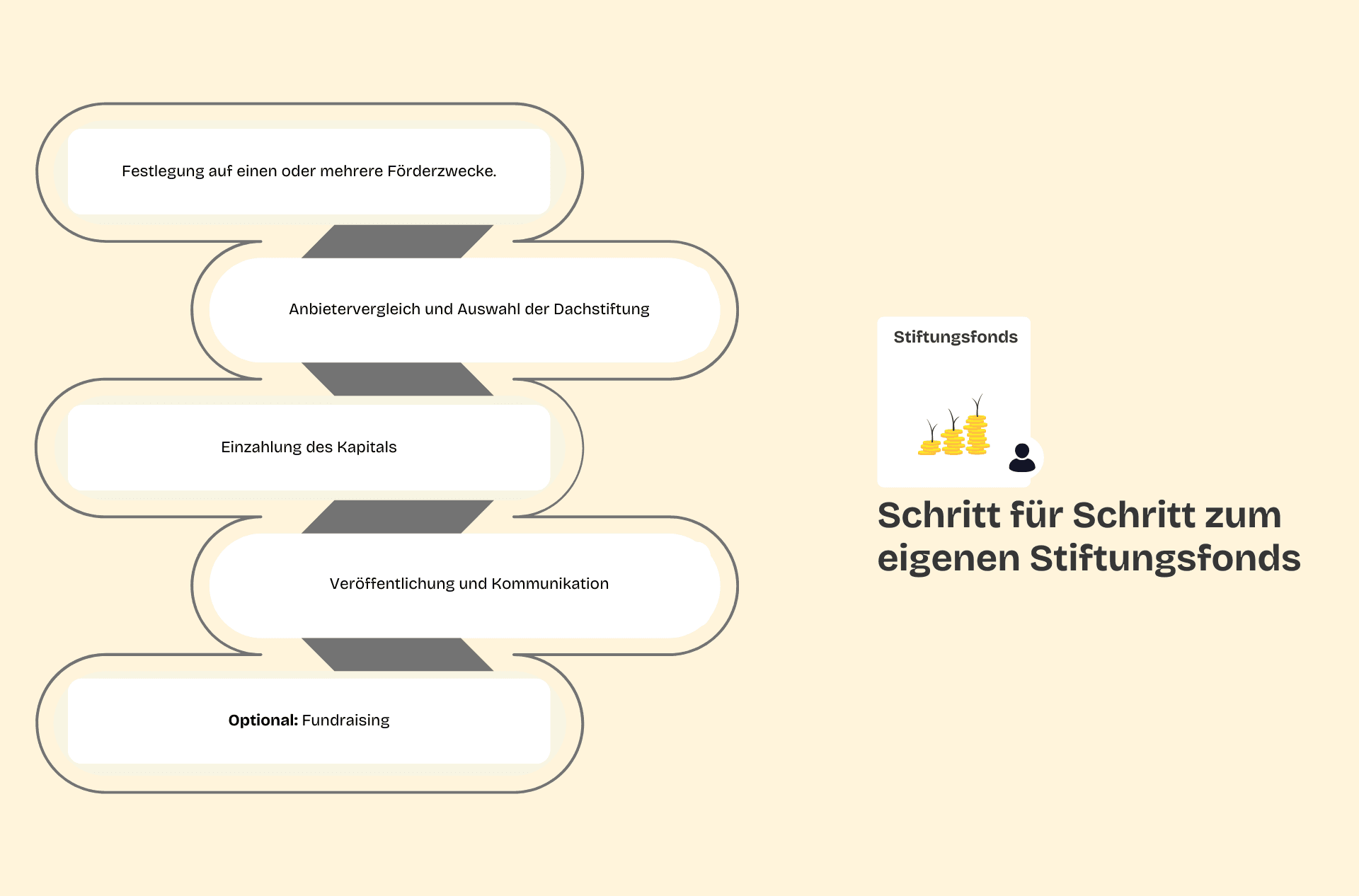
Commitment to one or more funding purposes: Decide on a cause close to your heart and think about how you can best support it.
Comparison of different providers and umbrella foundations: Consider the following aspects: preservation principle, consumable foundation (or trust foundation) or legally capable foundation, initial costs, flexibility of the constitutional purpose, digital administration, capability of fundraising.
Setup: Depending on the provider, you can start either with a personal consultation or directly digitally.
Start and payment of the capital.
Management, communication, and fundraising where applicable.
These providers of foundation funds you should know
Would you like to establish a foundation fund? Here you will find some points of contact that will help you with this venture.
NGOs and church-related umbrella foundations
In Germany, some large NGOs and church facilities offer the possibility to establish foundation funds under their umbrella. Organizations such as SOS Children's Villages or the Malteser have established structures to enable private individuals or companies to set up and subsequently manage a foundation fund. As described above, the umbrella foundations take on all legal and administrative responsibility and take care of managing the funds invested for specific charitable purposes. In doing so, founders are often free to define the foundation's purpose, as long as it is compatible with the general goals of the respective organization.
Particularly advantageous is the close connection between the foundation fund and the operational projects of the NGO. In this way, founders can ensure that their funds flow directly and specifically into charitable projects that correspond to the principles of the respective organization. This type of foundation fund is particularly suitable for individuals who prefer direct support of established programs and projects without having to set up their own foundation.
Three advantages at a glance:
Established structures: NGOs and church facilities offer professional, already functioning structures that take on the legal and administrative management of the foundation fund.
Brand reputation: Most major NGOs enjoy high recognition and are trustworthy. This can positively affect the perception of your commitment.
Direct use of funds: The foundation fund is closely linked to the operational projects of the NGO, so that the funds are used directly and effectively for charitable purposes.
bcause
Another provider of foundation funds in Germany is bcause, whose model is based on the Donor Advised Funds known from the USA. bcause is a trust foundation in which private founders can easily set up a fund without going through the complex process of founding an independent foundation. Notarial certification or the determination of a rigid foundation purpose are not required. Instead, bcause makes it possible to establish an individual fund through donations, which legally functions as part of the higher-level trust foundation.
The administration is handled by bcause, which represents a significant advantage regarding the bureaucratic and administrative effort. This simple and flexible structure enables founders to guide their financial resources specifically into charitable projects while ensuring professional management of the capital as well as compliance with the legal framework.
Three advantages at a glance:
Large selection of organizations: You can either onboard your own organizations or choose from over 500 already available organizations.
Flexible selection of impact goals: You have the option to flexibly select and adjust your target organizations at any time.
Favorable costs and digital setup: Costs are comparatively lower, and you can handle the entire process conveniently online.

✨ Discover the new way of doing good. Receive exclusive access to the digital and free foundation guide – for commitment without bureaucracy, but with full impact.
👉 Get the digital foundation guide now
Other examples
In addition to the large NGOs and specialized platforms like bcause, there is a variety of other providers in Germany that offer foundation funds under their umbrella. For example, the German Foundation Center (Deutsches Stiftungszentrum) manages a foundation fund with assets of 4.1 million Euros. The purpose of the fund is the promotion of science, education, and upbringing.
Banks and other financial institutions, such as Sparkassen, also offer the setup of a foundation fund by providing access to a founder community.
Conclusion
A foundation fund is neither a foundation nor a direct donation to an organization. It offers a simple and effective path for everyone who shies away from high costs and bureaucratic hurdles, but still wants to engage publicly and systematically with their money. Foundation funds are the modern alternative for all those seeking a philanthropic vehicle with lower costs, minimal bureaucratic effort, and the possibility to set individual focus areas. If the limitations of restricted control, lack of operational activity, and dependence on the umbrella foundation are not an obstacle, several providers in Germany already offer the establishment of a fund.
For individuals or companies wishing to achieve a long-term, sustainable impact without carrying the administrative baggage of a classic foundation, foundation funds are the ideal solution.
About the author: Nicole is Chief Legal Officer at bcause and answers complex legal and infrastructural questions regarding foundation establishment, trust foundations, and financing flows. She is also the managing director of our bcause trust foundation. Nicole led legal departments at PayPal and Groupon and worked as an attorney.
"
Sign up for our newsletter and never miss a thing.
⚠️ Disclaimer: We do not provide tax advice. We do not replace a certified tax advisor. All information is provided without guarantee.
Written by

Nicole Weyde