People & Stories
Christian Vollmann: What drives him to make a sustainable change to the world
In the podcast 'Das Neue Geben', business angel Christian Vollmann talks about his journey to becoming an impact investor and why giving up is not an option for him.
—
9 minutes

In the podcast “Das Neue Geben”, Felix and Janina talked to Christian Vollmann. To make it easier to read, the conversation has been shortened and adapted in some places. You can listen to the full interview here:
A Role Model for Social Commitment and Entrepreneurial Innovation
Christian Vollmann is a serial founder, business angel, and a significant figure in the German startup scene. After his studies, he worked for the Samwer brothers on the eBay clone Alando, among other things, and founded the dating portal iLove in 2003. He quickly found his passion in entrepreneurship, followed by the matchmaking service eDarling and the video platform MyVideo. After successfully selling these companies, Christian used the profits to become active as an impact investor. As a business angel, he continues to support a large number of impact startups that are committed to a sustainable future. He is co-founder of the social enterprise nebenan.de, which is a platform that strengthens local communities and promotes social cohesion. His current project: The climate-tech company C1 Green Chemicals, which develops innovative solutions for the production of green methanol. As a role model for social commitment and entrepreneurial innovation, he was honored by the Business Angels Netzwerk Deutschland e.V. in 2017 and inspires others to combine their entrepreneurial activities with a positive impact on society.
Christian Vollmann Interview: His Path to Becoming an Impact Investor
Hi Christian! You founded the climate-tech startup C1 Green Chemicals. How did the founding idea actually come about and can you explain what exactly you do?
I have reinvented myself over and over again throughout my life. At first, I was a digital entrepreneur and fascinated by the internet, for example through MyVideo and other projects. In my first impact startup, nebenan.de, we were concerned with social cohesion and how hyper-local neighborhood networks can promote it. Today, three million people use the platform to exchange ideas, help, and share things – and to experience real neighborhood life again. I left the company three years ago because I wanted to take a new direction, strongly motivated by my children. My oldest son, who was ten at the time, started to worry about climate change and asked me questions that I no longer had answers to. He wanted to know what I do as an entrepreneur, and when I explained that I solve problems, he asked: „There is really only one big problem. Why are you wasting your time on anything else?“ That drove me to take action. However, I quickly realized that as a digital entrepreneur it is difficult to contribute to the solution. We have excellent science, we have great engineers, but we are no longer as good at commercializing and, above all, scaling it. Therefore, I decided that as a company builder, I could have the biggest impact by doing exactly this and supporting a scientific team. With C1, we are working on a climate-tech startup that is reinventing methanol production using quantum chemistry. The potential is vast, but initially we are focusing on methanol. Why methanol? If it is produced renewably, it can defossilize shipping and be used as a feed stock in chemical manufacturing.
“Money you get, you have to send back out into the world so it can work and create entrepreneurial value.” - Christian Vollmann on the effect of money
How did you start working with money, or when did your understanding of money develop?
Talking about money is difficult, at least that is my perception. It is not an easy topic in this country either: if you have money and spend it, you are considered a show-off. If you don't spend it, you are considered stingy. My own money story began in simple circumstances. We were not poor, but it was clear that money is something you have to work for. For financial reasons, my parents could not go to university, although they had the potential to do so. Therefore, they decided to do everything they could to ensure that their own children received the education they deserved. That meant an enormous amount to me, and they supported my wish to study at a private university. They never expected me to repay them, but rather to do the same for my children. As a result, I felt implicitly very committed to showing them that this investment in my education was worth it. So I started to focus on earning money and did an internship at Alando, the predecessor of eBay Germany, while I was still studying. Before that, I had already founded my first company and quickly realized that this suited me well and was fun. I wanted to be part of the internet revolution and decided to build the dating platform ilove.de. After starting to invest my money relatively early on, I had my first successful quasi-business angel exit with Moneybookers. For me, it has always been the case: money you get, you have to send back out into the world so it can work and create entrepreneurial value. Because in the end, money is just a means to an end to achieve a goal. Of course, that's easy to say when you have enough of it. I feel more relaxed because I know that I earned my money myself and don't owe anyone an account, except to myself.
You realized early on that it makes sense to invest the money you earn. When was the moment when it clicked for you?
My mother, as a trained bank clerk, taught me the basics about interest and compound interest. However, my parents did not have any large stock investments, as they viewed shares as risky. Before my first success, I was 100 percent an entrepreneur and just wanted to be successful. At times, I put 80 percent of my entire savings into MyVideo. The platform was very successful in Germany and benefited from positive network effects, but the bandwidth was extremely expensive. The bills soon rose to six figures per month, so I had to shut down MyVideo.fr despite growth in order to save MyVideo.de - that's hard to imagine today. The sale of MyVideo at the end of 2007 to ProSiebenSat.1 was then the moment when I had a relevant amount in my account for the first time and had to think about investments. I taught myself how to invest and focused on business angel investments. Since 2005, I have invested in almost 100 companies, which is an average of five per year. The second leap in awareness came after E-Darling, when I asked myself why I actually always wanted to start new companies. My bank balance was rising, but I felt this diminishing marginal utility of even more money more and more.
More 'Click Moments'
💡Discover many more exciting conversations about personal aha moments, big ideas, and the courage to break new ground.
In your opinion, what would need to happen for a larger part of the German tech and startup scene to have the confidence that it is worthwhile to invest in impact?
The deeper I dive into the topics, as now with C1 in the energy transition, the more I realize how challenging that is. I think we have to be patient and keep drilling. What we also need, of course, are success stories - we need role models and trust. And trust has to be built slowly over a longer period of time by consistently doing what we say we will do. It cannot be forced. As Warren Buffett shows, this compounding effect becomes enormous over time. In megatrends like the internet, short-term successes were often overestimated, while long-term effects were underestimated. If people had said back then how big Amazon, YouTube, or Google would become, many would have thought it unrealistic. We are still at the beginning, but the problem with climate change is that time is pressing and unfortunately we started much too late.
“Giving up is simply not an option.” - Christian Vollmann on his intrinsic motivation
What motivates you to remain active in C1 Chemicals and impact investing?
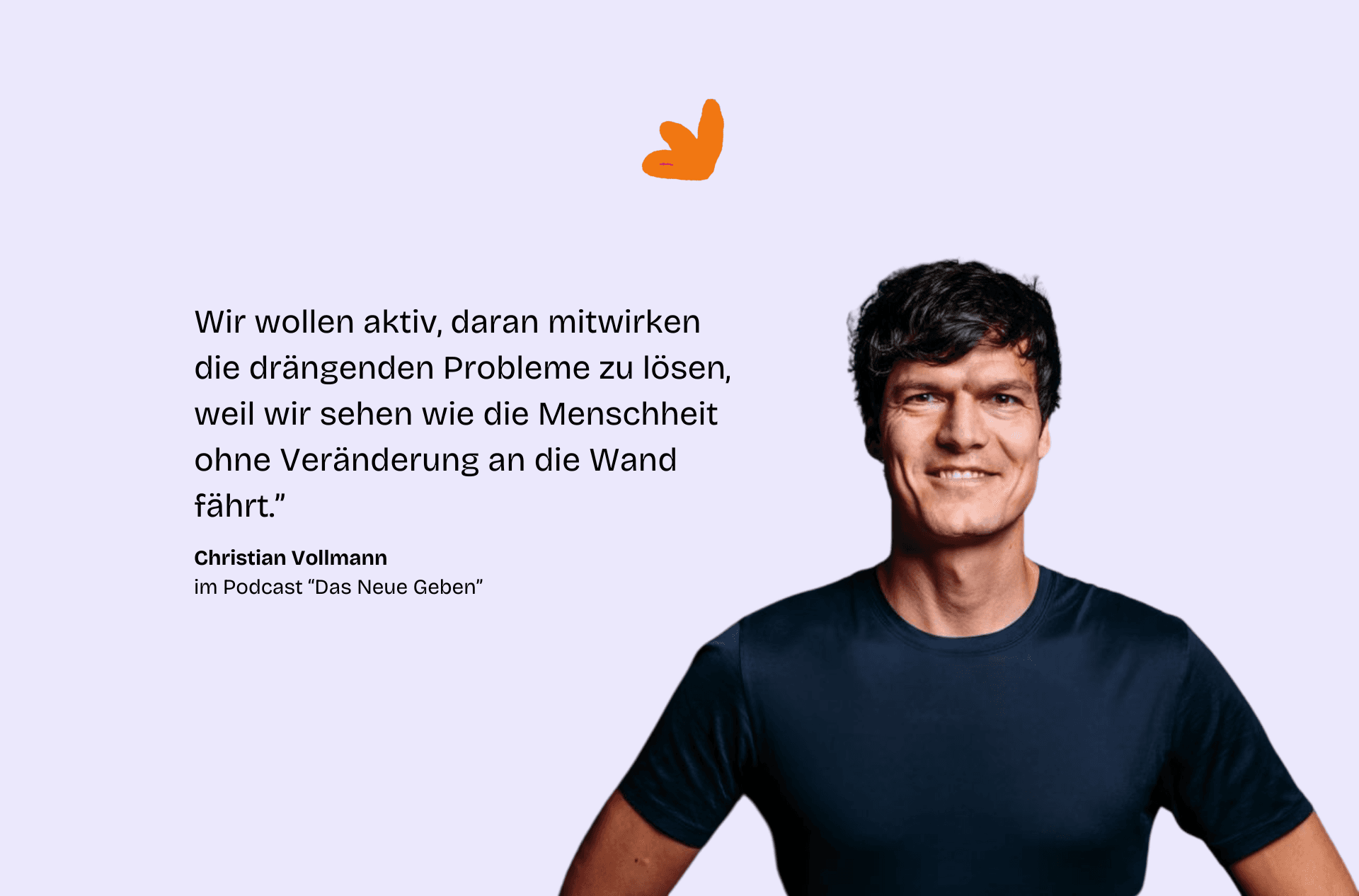
The disadvantage is that it is much harder because the task is so much bigger. The advantage, on the other hand, lies in the intrinsic motivation: we want to actively participate in solving the urgent problems because we see how humanity is running into a wall without change. In the past, my motivation was more of a
Sign up for our newsletter and never miss a thing.
⚠️ Disclaimer: We do not provide tax advice. We do not replace a certified tax advisor. All information is provided without guarantee.
Written by

Felix Oldenburg