People & Stories
'Social Movements as Engines of Change' – Antonis Schwarz
Guerrilla donor Antonis Schwarz speaks about impact investing and activism in an interview on "Das Neue Geben". Find out more now!
—
8 minutes

In the podcast “Das Neue Geben” (The New Giving), Felix and Janina spoke with Antonis Schwarz. For better readability, some parts of the conversation were shortened and adjusted. You can listen to the full interview here:
A millionaire heir with a mission for social change
Antonis Schwarz is an impact investor, philanthropist, and activist. And with that: definitely one of Germany's most committed millionaire heirs. Possessing a large fortune early on after the sale of the family pharmaceutical company Schwarz Pharma in 2006, it was clear to him that he wanted to use his means to drive social change.
At the beginning of his impact journey, he worked at Ashoka and eventually decided to become part of the support network. **After completing his master's degree, he co-founded the non-profit organization Vouliwatch, which advocates for transparency and citizen participation in the Greek parliament. With his Guerrilla Foundation, founded in 2016, he supports social movements and activist networks working for comprehensive system change across Europe. Furthermore, Antonis is a co-founder of the Center for Sustainable Finance and Private Wealth at the University of Zurich and is actively involved alongside the Social Entrepreneurship Netzwerk Deutschland (SEND e.V.) in establishing a German Social Impact Fund financed via unclaimed assets. As a member of the initiatives Millionaires for Humanity and taxmenow, he lobbies for national and international tax justice.
Interview with Antonis Schwarz on activism and impact investing
Hi Toni! Following your inheritance, you decided early on to use your wealth for social change. Tell us how your impact journey began.
I am half Greek, half German, and grew up in Munich. After World War II, my German family founded a pharmaceutical company, which was sold in 2006. I also inherited from those proceeds. However, until my early to mid-20s, I left the money with the wealth manager so I wouldn't have to think about it too much and could focus on studying first. After my master's degree, I decided to found Vouliwatch as a non-profit organization in Greece, which focuses on transparency in politics there. For this, I invested larger sums of money for the first time. I moved to Athens, hired a team, and the NGO has now existed for over ten years. Managing wealth at a young age wasn't easy because feelings of shame are often associated with it. I hadn't earned the money myself, after all, and wanted to lead my own life first without drawing on family wealth. Today, I work part-time at Phineo, an engagement advisory firm, where I focus on impact investing. Although I feel the urge to devote myself exclusively to philanthropy and impact investing, I appreciate having one foot in reality.
What was the impulse for you to found the non-profit organization Vouliwatch back then?
There were several impulses that motivated me to take that step. On one hand, my master's degree in management was heavily focused on financial success. The focus of my fellow students was primarily on careers in investment banking and maximizing wealth – which increasingly repelled me. I wanted to take a different direction, assisted by the inheritance that gave me the necessary financial freedom. On the other hand, my Greek heritage played an important role. Although I grew up with a strong connection to Greece, over the years I had less and less contact with my mother's country. At the same time, the media highlighted Greece's economic and social problems very clearly, reinforcing my feeling of wanting to act as a Greek citizen. Through my experiences at BonVenture and my knowledge in political science, the idea arose to found an NGO that, like Abgeordnetenwatch, deals with transparency in politics – an area that was barely covered in Greece at the time. The decision was made at a time when Greece was in the global spotlight, making the project particularly relevant.
How did the founding of the Guerrilla Foundation come about then?
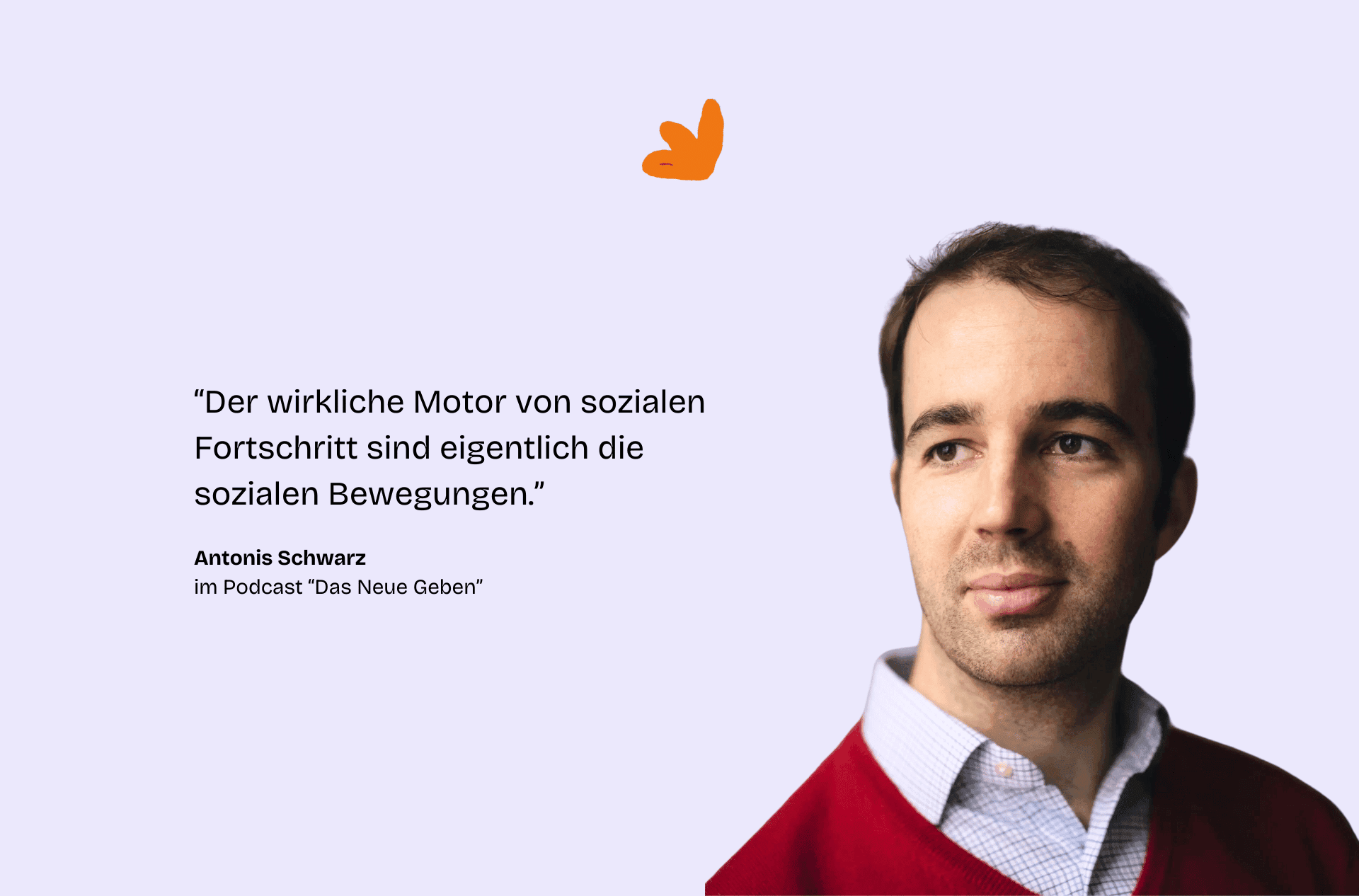
During my time in Greece, I began supporting various NGOs, especially in refugee aid and international activism projects. An important moment was in 2014 when I got in touch with Philipp Ruch from the Zentrum für Politische Schönheit (Center for Political Beauty). Their actions showed how much influence can be achieved in social discourse with relatively few means, which inspired me greatly. It became clear to me that more funders are needed who also support unconventional and provocative initiatives. Through my work with the Bewegungsstiftung, which supports social movements, I gained my first insights into the concept of Social Justice Philanthropy. I was particularly inspired by Fahad Ibrahimi of the Chorus Foundation in the US, who also supports social movements. For me, it was clear: the real engine of social progress is actually social movements. When we founded the Guerrilla Foundation, I hired Romy Krämer as managing director, a position she still holds today. Initially, we supported social entrepreneurship and refugee relief, but then focused exclusively on supporting social movements and activists. Privately, I continue to be involved in refugee aid. The underlying idea of the Guerrilla Foundation is based on the conviction that grassroots movements, especially in their early stages, receive too little financial support. Many activists work on a voluntary basis alongside their day jobs, which often leads to overload and burnout. We want to close this gap and primarily support movements in Eastern and Southeastern European countries, where funding is particularly scarce.
“What is needed are networking and educational opportunities” - Antonis Schwarz on the challenges of inspiring social engagement
How do you manage to inspire other people for social engagement?
I organize a virtual roundtable for high-net-worth individuals in Germany, where we regularly exchange ideas on impact investing. Additionally, I host an annual Impact Investor Gathering on Samos, where about 10 to 20 people come together. In philanthropy, we introduced a participatory model with the Guerrilla Foundation a year and a half ago. In this model, the team and the Activist Council, consisting of 12 activists, make decision about grants - without my direct involvement. Currently, over 1.9 million euros flow into the foundation, including my contribution of 750,000 euros. We also have a platform where we share our financial stories. I believe what is needed are networking and educational opportunities. For example, the University of Zurich, in cooperation with MIT, offers the course „Impact Investing for the Next Generation“. There you learn the necessary expertise as well as meet like-minded people with whom you can exchange ideas. For me, this course is the gold standard in the field of impact investing. It is important to find your own path and keep educating yourself.
What is your long-term vision for your projects and engagements?
That is an interesting question. My path was often shaped by coincidences and unexpected acquaintances. Currently, I face the challenge of managing my money wisely without spending it thoughtlessly. Even though I have wealth, my means are limited, and I carefully consider how to deploy them for the greatest possible impact. Currently, I am working on a project in Greece focused on promoting reusable cups. Unlike initiatives like Recap or Vital, which are more widely known in other countries, this concept is not yet widespread in Greece. I am working to make reusable cups more popular in beach bars, hotels, and events. Even though this project is not particularly large, I invest a lot of time and energy into it. In Greece, starting such projects requires substantial effort and patience.
Which current social issue concerns you the most?
The Greek government's policy regarding refugees is concerning. On Samos, where we have a summer house, a new refugee camp was built with EU funds totaling over 40 million euros. When refugees arrive there, they must spend 2-3 weeks in a form of isolation without receiving new clothes. So, they have to stay in the same clothes they arrived in. This is just one example of the difficult conditions they have to go through. There are many other challenges and harsh experiences that people are faced with there.
Moving more together
💡 Did you know: There is also a newsletter for the blog. You can easily sign up at the bottom of the page and never miss an issue. If you are interested in what topics the newsletter has already set in motion, you are in the right place: All issues of the newsletter.
Listen now!
If you would like to hear even more about Antonis' commitment and views, you can listen to the complete interview as a podcast. You can also find the podcast episode on Spotify.
For questions and comments, feel free to write to us at community@bcause.com.
Sign up for our newsletter and never miss a thing.
⚠️ Disclaimer: We do not provide tax advice. We do not replace a certified tax advisor. All information is provided without guarantee.
Written by

Felix Oldenburg