People & Stories
Financing Systemic Change: A Conversation with Dr. Maja Göpel
Insights from the May Masterclass at Club Neues Geben
—
3 minutes
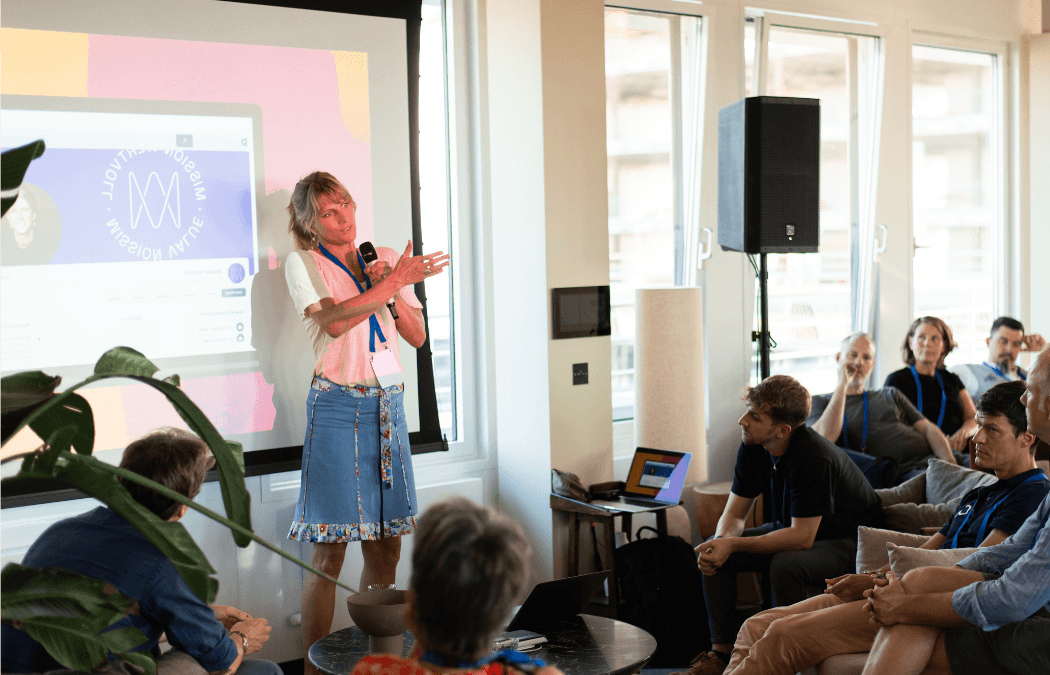
Insights from the May Masterclass at Club Neues Geben
In May, political economist and transformation researcher Dr. Maja Göpel was a guest at the Club Neues Geben to take a look beneath the surface of our economic system with us. Maja talked with us about why the current rules for money and markets are not laws of nature, but rather a kind of human-made "software" that urgently needs an update. But above all, it was about the question that occupies many of us: Where does private wealth have the greatest leverage to trigger this update and bring about real change?
For anyone looking for answers to the question of how philanthropic engagement can drive systemic change, we have prepared the key theses from the conversation with Felix Oldenburg here.
Felix: Maja, you speak of a "mental infrastructure" that determines our actions. What does that mean for philanthropists who want to make a difference with their money?
Maja Göpel: It means recognizing that we are often only treating the symptoms of a sick system. The "mental infrastructure" is the deeply embedded rules of the game of our economy – and these are human-made. They are not laws of nature, even though they are often presented as such. These rules systematically favor the accumulation of financial capital, while real values such as an intact nature, education, or social cohesion are dismissed as costs or "externalities."
An absurd but real example of this is the work of the German National Regulatory Control Council (Normenkontrollrat). Its purpose is to measure bureaucracy costs.
According to this logic, investments in children and fair wages are a pure cost factor because the long-term social benefit does not feature in the measurement at all. The greatest leverage for philanthropy lies in no longer merely mitigating the consequences of this system, but in changing the flawed rules of the game themselves.
Felix: Where can an individual of wealth even start to change the "rules of the game"?
Maja Göpel: This is exactly where the unique opportunity of private capital lies. It can invest flexibly and courageously where there is (as yet) no classic business model. I see a powerful three-step approach for effective philanthropy:
Donating where the market fails: Rewetting peatlands is a perfect example. It is one of the most effective CO2 sinks we have, but there is no market-based model for it. Philanthropy can step in here and regenerate this vital natural capital. The same applies to investments in social cohesion, in independent journalism, or in strengthening local, democratic structures. It's about rebuilding the fundamental forms of capital – natural capital, social capital, human capital – that our current economic system is eroding.
Strengthening the political infrastructure: This is the most effective lever. It is about funding the "operating system of change." Support organizations that work on the political framework conditions. This is not an "abstract" donation, but an investment in the foundation of everything that comes after. Think tanks like Dezernat Zukunft or educational initiatives like the Netzwerk Plurale Ökonomik do crucial work here. They build coalitions, inform policy-makers, and bring new, sustainable narratives into the public eye so that they eventually become the new norm.
Investing better and supporting pioneers: When we invest, we need to ask new, smarter questions. Not just: "What is the financial return?", but: "What is the social and ecological return?". We need to expand the criteria for a good investment: Is the time horizon long enough (at least 10 years)? Are the criteria broad enough (social & ecological aspects included)? And is the spatial context large enough (global impacts considered)? Here, we can specifically support pioneers who develop new, sustainable business models. Venture capital funds like Planet A Ventures do exactly that by funding start-ups like traceless materials that focus on a circular economy and real, measurable impact from the very beginning.
Felix: Many wealthy individuals feel pressured to secure their money primarily for their own family rather than "risking" it for such purposes. What is your response to that?
Maja: I would take the sentence "I want my children to have it better" and seriously re-interpret it. In today's world, "better" no longer just means "more." It means living in a society with clean air, stable democratic conditions, and a high degree of trust.
"Why haven't we noticed that having more no longer aligns with becoming happier [...]?"
Purely financial provision is an illusion of security when the systems around us collapse. Maja shared the strategy of Dubai, which is now massively collecting foreign currency to buy land in Africa because they know their own land will sink due to climate change. This is the ultimate consequence of a purely extractive logic. An investment in our shared social foundations is therefore the safest and most valuable investment for the future of our children. It is not competing with family provision, but rather its necessary prerequisite.
Compass for Action: Further Links
By and with Maja Göpel:
Podcast "NEU DENKEN" by Mission Wertvoll: To the podcast website mission-wertvoll
Her organization "Mission Wertvoll": To the website
Books & studies that expand horizons:
"The Code of Capital" by Katharina Pistor: More information (Princeton ... press.princeton
OECD Better Life Index: To the index oecdbetterlifeindex
The Easterlin Paradox: To the article in the online encyclopedia ... lexikon.stangl
Organizations driving the change:
Dezernat Zukunft: Think tank for a new monetary and economic policy. To the donation page on bcause
Netzwerk Plurale Ökonomik: For more diversity in economic education. To the donation page on bcause
Planet A Ventures: VC fund for green-tech startups with measurable impact. To the website planet-a
traceless materials: Startup providing a sustainable alternative to plastic. To the website traceless
Scientists for Future: To the website
Political framework conditions:
EU Nature Restoration Law: The law for nature restoration. Information from the EU Commission... environment.ec.europa
German Federal Environmental Foundation (DBU): One of Europe's largest foundations for environmental protection. To the website dbu
Maja Göpel is a political economist, transformation researcher, bestselling author, and founder of Mission Wertvoll. She was a guest at the Club Neues Geben, a closed circle of people who want to give more, together and regularly exchange ideas on the topic.
Sign up for our newsletter and never miss a thing.
⚠️ Disclaimer: We do not provide tax advice. We do not replace a certified tax advisor. All information is provided without guarantee.
Written by
Katharina Bauch