Trends
Three disadvantages of charitable foundations
Statistics prove that people are founding fewer and fewer charitable foundations. Here are three potential reasons that could explain this.
—
8 minutes

Climate crisis, democratic deficits, or global tensions. In a time when societal engagement and effectively deployed private wealth are indispensable, it seems all the more paradoxical that fewer and fewer people are establishing a charitable foundation. Yet, this is what is stated in a report by the Association of German Foundations (Bundesverband deutscher Stiftungen) from 2024.
The basic idea of a charitable, private foundation is actually compelling: an asset is permanently dedicated to a good cause. This can involve money – historically, however, it was mostly about land, buildings, or cultural assets that represented such a great value to the general public that they needed to be protected from misappropriation by future generations or especially the state.
In addition to the basic idea, however, founding a charitable foundation also has several disadvantages. Because if one wishes to put a project into practice today, one quickly realizes that charitable foundations unfortunately often stand for a complex network of service providers, rigid regulations, and not insignificant restrictions.
📚 Table of Contents
What should a charitable foundation be able to do?
Why founding a charitable foundation can become a challenge
Conclusion
What should a charitable foundation be able to do?
But first things first: the endeavor, as already hinted at above, to let a portion of one's money work for a good cause is the core of every charitable foundation. To put this plan into action, I believe three things in particular are needed:
Transparency
Temporal flexibility and simplicity
Tax-effective engagement
A charitable foundation must be transparent. It must communicate traceably to outsiders about its activities, finances, and decisions, and be accountable to its stakeholders: which target organizations or projects received what amount from the foundation, and when? The public perception of foundations is double-edged: on the one hand, most people associate foundations with something solid, but they also think of tax-saving models and personal vanity. That is why it is important not to obscure the work of the foundation through complex structures, but to explain through transparent communication what the contributed money is being used for. This builds trust among donors, supporters, and the general public, thereby allowing the foundation to safeguard its legitimacy and credibility.
Binding money to a good cause forever is the basic idea of the charitable foundation. It is obvious that the good cause can range from educational initiatives and supporting local projects to global climate protectors. Tackling societal challenges and contributing to overcoming them with private wealth is definitely time-critical. In a time when the "cost of doing nothing" ensures that solutions to global challenges cost two to six times more, precisely this time frame in which the money is active, as well as the flexibility and room for maneuver to adapt the foundation's purpose in the long term to personal needs, play a crucial role. The world is constantly changing, and successful foundations must be able to adapt in order to respond to new challenges and developments. This requires continuous improvement, open dialogue, and a willingness to adjust and revise existing strategies and programs to achieve the greatest possible impact. Because that is what the charitable foundation is mostly about: impact.
When you do search good, the state rewards it. Wealth that is contributed to a charitable foundation is tax-deductible. This means that both the founders themselves and third parties who make additional contributions benefit from tax advantages. Through these tax incentives, the state promotes engagement for charitable purposes and encourages people to donate more and get more involved in charitable projects. This creates a win-win situation: the foundation receives more funds to pursue its charitable goals, and the donors benefit from tax relief.
In short: The charitable foundation is meant to serve as a vehicle that uses a certain sum of money for social and ecological purposes, and does so ideally in a flexible, transparent, and tax-deductible way for all parties involved.
Why founding a charitable foundation can become a challenge
In the following, I would like to address a few hurdles that, in my experience as former Secretary General of the Association of German Foundations, are often topics of discussion and concern for aspiring founders. These points show why the concept of charitable foundations may require a fundamental overhaul.
Regulations and Services Industries - Where does foundation assets disappear to?
A significant stumbling block on the way to founding a charitable foundation is the opaque web of service providers offering complex solutions for the assets to be used. From asset managers and lawyers to tax advisors – selecting and coordinating these experts can turn into a time-consuming and costly affair.
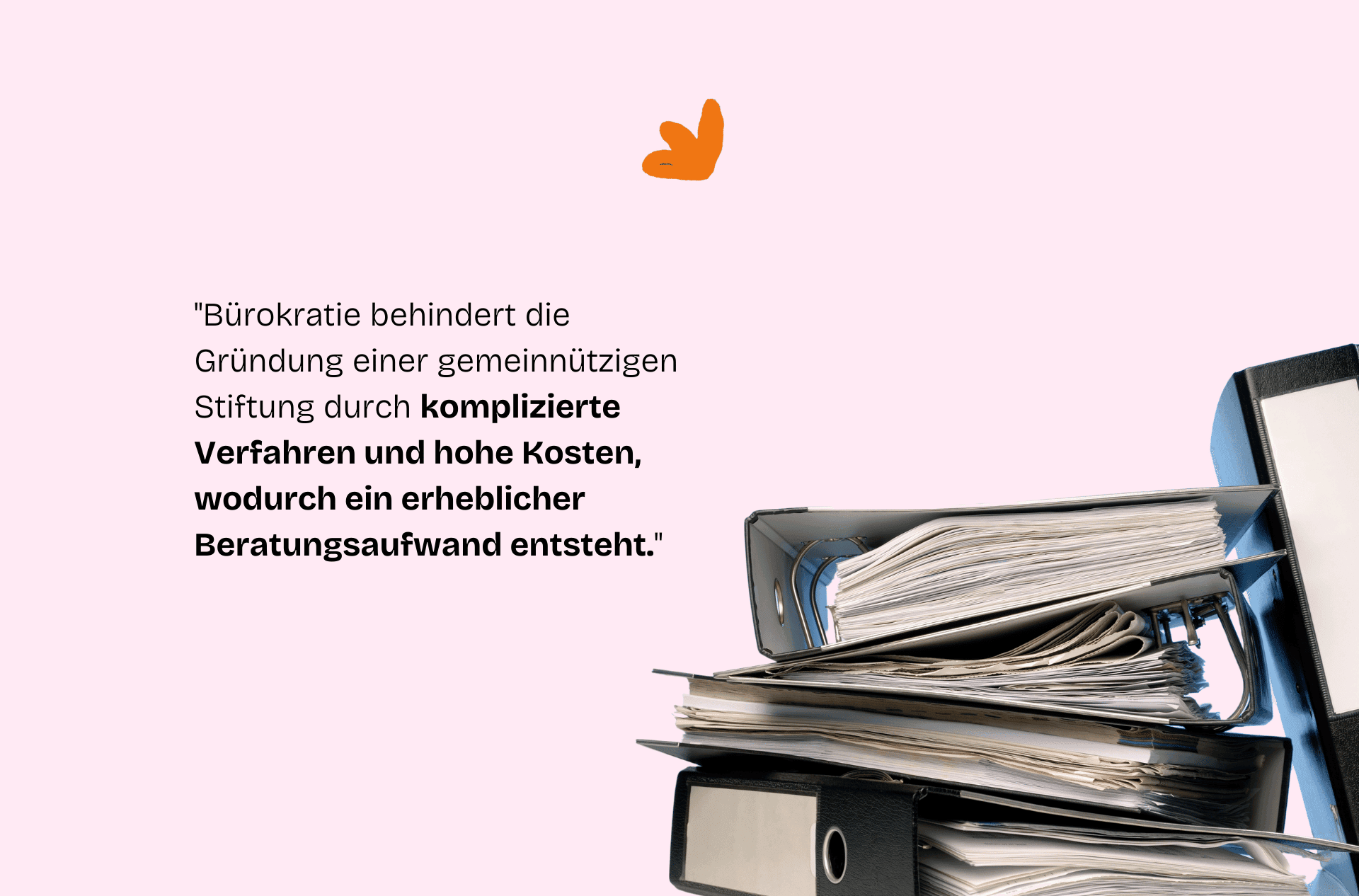
🤔 Thought experiment: Imagine if, when choosing a smart home system, you first had to consult and coordinate numerous specialists such as electricians, IT professionals, and security experts. This process would not only be complicated and expensive but would deter many from even considering the solution.
It is a similar story with founding a charitable foundation. A few examples are:
Asset managers are responsible for investing and managing the foundation's assets optimally.
Lawyers establish the legal foundation and ensure that the foundation complies with all statutory requirements.
Tax advisors monitor the correct implementation of tax requirements and optimize to ensure the most benefits.
Coordinating these service providers requires significant financial resources and a lot of time, which deters many potential founders. Yet the idea of putting a portion of one's wealth to use for a good cause in the long term is not nearly as complex as the process suggests.
Instead of subjecting themselves to it, many people, given the urgency, look for simpler and more flexible ways to do good. To make foundation-building more attractive, we therefore need a clear solution that works without consulting effort, legal know-how, and high costs.
Saving the world with the foundation's "breadcrumbs"?
With charitable foundations, it is usually the case that the principal asset remains untouched and dormant, while only the returns from the invested capital are used for the good cause. This means that only the interest and dividends – the "breadcrumbs" of the capital – may be utilized. This is intended to ensure that the foundation can a) exist in the long term, b) always have a stable financial basis, and c) remain capable of acting even in economically difficult times.
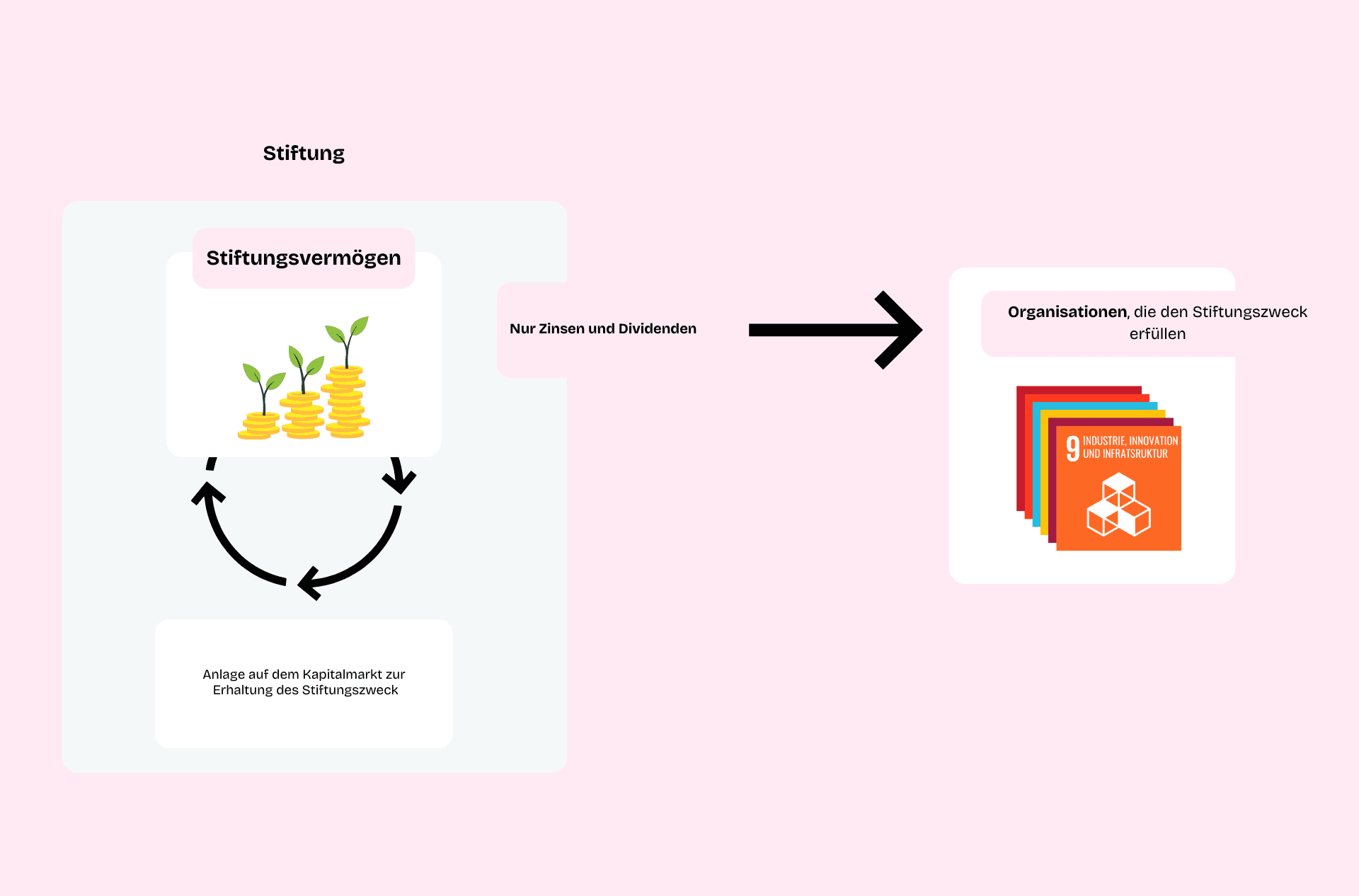
As a result, the contributed capital is "locked in" to generate continuous returns, which can then be used for charitable purposes. This approach prevents the foundation from depleting its assets and eventually becoming unable to support its charitable projects. Thus, the foundation's foundation remains stable and guarantees that it can continue to do good in the future, regardless of economic fluctuations or market crises.
But here's the catch: in times of low interest rates or economic uncertainty, these returns can turn out to be quite meager. Consequently, the budget for projects is often tight, while the capital itself remains untouched. Ergo, foundations have little room for maneuver for what is actually the ultimate goal: impact.
Combined with the infrastructure described above, this means that foundations often have to hire expensive asset managers and consultants to make the most of the returns. This makes the entire process even more complicated and costly, which simply makes the charitable foundation a more inflexible option. A clearer, simpler solution without high consulting efforts and immense costs could be much more attractive here.
Flexibility: problems change, the foundation's charter remains the same
A frequently asked question is whether the initially established foundation purpose can be changed. The answer to this is, in most cases, a clear no.
The foundation's purpose generally cannot be changed. It reflects the will of the founder and sets the direction for the foundation. All decisions of the foundation bodies must necessarily be guided by it, and the purpose remains permanent and cannot be changed over time, unless it is fundamentally impossible to achieve anymore. Consequently, this means that a foundation's assets are permanently tied to a specific purpose established at the time of founding.
Even if societal needs or the priorities of the founders change over time, the foundation remains obligated to manage and deploy the assets in accordance with the originally defined purpose. Thus, a foundation established many years ago with the goal of education cannot simply reallocate its funds to address environmental issues, for example.
So if you want to act with your assets in a temporality flexible way and in response to global crises, the traditional charitable foundation is not an optimal solution for this.
Did you know?
bcause offers versatile ways to approach foundation founding simply, flexibly, and cost-effectively.
For everyone who wants to make a bigger impact together
For your corporate social engagement as a company
Conclusion
To make charitable foundations more attractive, three key aspects should be addressed.
The opaque web of service providers, the trapped foundation assets (or as I often call it, the "money prison"), and the rigid commitment to the foundation's purpose.
More transparent and accessible services could reduce the consulting effort and lower costs. More flexible asset management would ensure that funds can be deployed effectively to react flexibly to societal needs.
Additionally, a revision of the legal framework could enable foundations to adapt their purpose in order to maximize their impact while providing legal certainty. Ultimately, charitable foundations should aim to pass on funds efficiently and flexibly to organizations that want to bring about positive change.
About the Author: Felix is the CEO of bcause and writes about how people are engaging financially in a stronger and better way today. The board spokesperson of gut.org previously helped shape the world of foundations as Secretary General of the Association of German Foundations and the social entrepreneurship movement as European Director of Ashoka.
Sign up for our newsletter and never miss a thing.
⚠️ Disclaimer: We do not provide tax advice. We do not replace a certified tax advisor. All information is provided without guarantee.
Written by

Felix Oldenburg