Taxes & Legal
bcause under tax law review with attorney-at-law Alexander Vielwerth
Lawyer Alexander Vielwerth explains the donation system behind bcause, highlighting the differences compared to a classic foundation. Read now.
—
6 minutes

The New Giving explained simply: We spoke with Alexander Vielwerth, an experienced lawyer and expert in tax, non-profit, and foundation law. At the beginning of 2023, a client told him about bcause as an alternative to establishing a traditional foundation. Since then, he has been happy to recommend this option to other clients looking for a simple tool for philanthropic engagement. In our conversation, he explains what advantages a digital foundation offers from his perspective and what the limits of the model are. In doing so, he evaluates bcause from a tax perspective and shows how a bcause Foundation differs from establishing a traditional foundation. For better readability, the conversation has been edited and shortened in some places.
A 'Lawyer for the Good Cause'
Alexander Vielwerth is an independent lawyer at the law firm Vielwerth Junginger. Within corporate and tax law, his focus is on associations, foundations, gGmbHs, and cooperatives, as well as the entire law governing non-profit organizations. Above all, he helps non-profit organizations establish a legally secure framework for their activities. In addition, he acts as a moderator and facilitator for general meetings. Alexander has also been able to share his experience and knowledge as a lecturer at the Abbe-Institut für Stiftungswesen in Jena and the University of Münster. Driven by the desire for meaningful and sustainable work, he ultimately co-founded the network "Lawyers for the Good Cause" and the law firm Vielwerth Junginger together with Linus Junginger.
Explained simply: bcause Foundation vs. traditional foundation establishment
Hi Alexander! You came across bcause through an inquiry from a client who wanted to make a financial commitment without setting up a traditional foundation. How would you describe the differences between a Foundation at bcause and a traditional foundation in your own words, and what advantages does this model offer?
The biggest difference lies in understanding that the Foundations at bcause are not "real" foundations in the legal sense, but rather so-called foundation funds (Stiftungsfonds). These funds have nothing to do with a bank's investment funds – here, I am rather investing in something good. A foundation's assets are special assets that are administered separately by another organization – in this case, by bcause. In this context, bcause itself is not an independent legal foundation, but a trust foundation (Treuhandstiftung) administered by bcause GmbH. This might seem a bit complex legally, but in practice, it works seamlessly.
“The advantage of a foundation fund is that you can first gather money and then dedicate it specifically to a certain topic, such as the empowerment of women.” - Alexander Vielwerth on the advantages of bcause
Establishing a 'real' foundation, which is itself a legal entity and ideally also recognized as a non-profit, requires a lot of capital. In the past, the minimum capital was usually 50,000 euros; today, one expects closer to 100,000 euros. This means that recognition by the foundation supervisory authority is hardly to be expected with an endowment capital of less than 100,000 euros – even though there may be exceptions. Alternatively, I could donate my money directly to a non-profit organization. But the advantage of a foundation fund is that you can first gather money and then dedicate it specifically to a certain topic, such as the empowerment of women. This allows you to support numerous non-profit organizations active in this field. Instead of making many small direct donations, transparent and bundled support is made possible through your own Foundation. Furthermore, I can fundraise myself at events and thus gather donations for my Foundation, just as, for example, Julia Kupke did at her vernissage. This form of commitment is something special and unique – not directly comparable to a legally independent foundation or a simple direct donation.
How does the administration of a Foundation at bcause differ from that of a traditional non-profit foundation? How do you rate the donation model at bcause from a tax perspective?
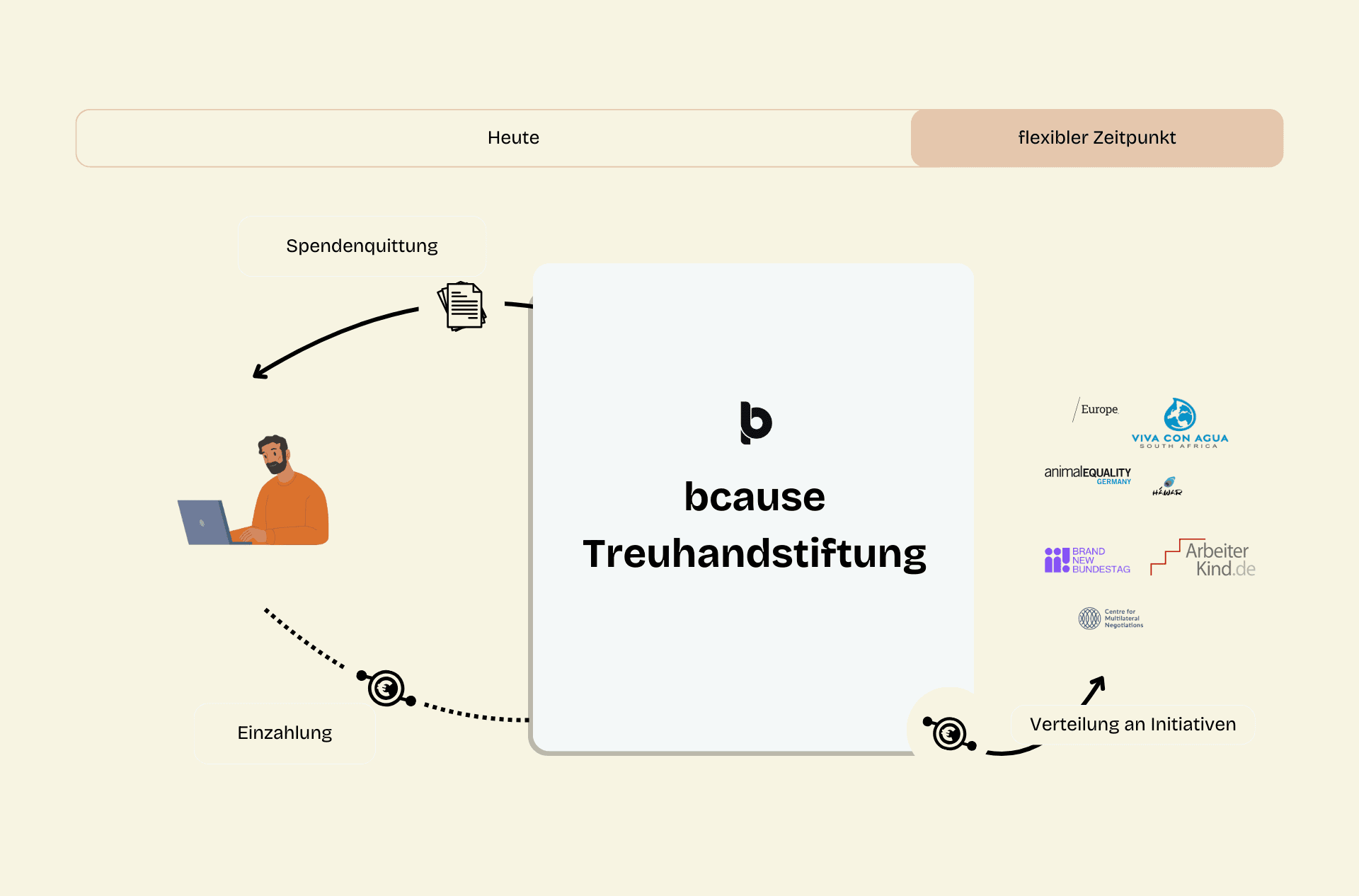
If I establish my own non-profit foundation, I am responsible for the administration myself – this includes accounting, non-profit law, and issuing donation receipts. However, because the Foundation is owned by the bcause trust foundation (Treuhandstiftung), the assets remain with bcause, which itself is recognized as a non-profit. The Foundation as such cannot be non-profit, and legally speaking, the donations flow directly to bcause. There, they are booked internally and transparently as special assets of the respective Foundation, and bcause issues the donation receipts (Zuwendungsbescheinigungen). This means there is no administrative effort for the users. When fundraising, however, you should briefly explain to donors why the bcause trust foundation is specified as the recipient of the donation and not the Foundation itself.
From a tax perspective, the model is straightforward and advantageous, as long as everyone understands that the donations go to the bcause trust foundation and that it also issues the donation receipts. Thus, from a tax standpoint, the donation works like a normal direct donation to a non-profit organization – in this case, to bcause. This means the donation amount can be claimed for tax purposes as special expenses up to 20 percent of total income per year, allowing donors to determine for themselves which purposes they wish to support with it.
An important difference, however, is that bcause acts as a trust foundation and not as a "full" foundation. This means the so-called endowment contribution (Vermögensstockspende) – i.e., the possibility, depending on marital status, to deduct up to two million euros tax-free spread over ten years when donating to the basic endowment of a foundation – is not possible here. Nevertheless, larger amounts could also be donated to a Foundation via bcause and claimed for tax purposes. In this process, the donation amount exceeding the allowance can be carried forward to future years.
“Without wishing to give a guarantee, with bcause you are in a very good place.” - Alexander Vielwerth
Foundations are sometimes subject to criticism - how do you rate the public perception of this?
There are indeed providers who market foundations purely as tax-saving models. This can create the impression that foundations are primarily an instrument used by wealthy individuals to minimize their tax burden. Nevertheless, foundations are predominantly perceived positively, especially when they operate transparently and clearly show how they pursue their charitable goals. Transparency is a key factor here in building trust and clearing up misunderstandings.
At bcause, this is particularly important because the trust foundation acts as an intermediary. To ensure this transparency, bcause is part of the Initiative Transparente Zivilgesellschaft, and founder and managing director Felix Oldenburg has also been actively committed to more openness and traceability in the non-profit sector for many years.
Ultimately, what matters is that you inform yourself well as a donor or supporter. You should understand how a foundation or platform works, what goals it pursues, and how it implements them. Without wishing to give a guarantee, I think that with bcause you are in a very good place.
Your commitment on bcause
We are happy to support you on your way to your digital foundation with a free initial consultation.
Arrange an initial consultation now
Sign up for our newsletter and never miss a thing.
⚠️ Disclaimer: We do not provide tax advice. We do not replace a certified tax advisor. All information is provided without guarantee.
Written by

Katharina Bauch